
Powder brows healing stages: what happens from day one to the retouch
Every client gets this timeline on paper before she leaves my chair, and most of them still message me on day ten to say the brows have disappeared. They have not. This is what each stage looks like, why it looks that way, and what to do about it.
Why powder brows change so much in the first month
I place pigment as thousands of fine dots in the upper layer of the skin. The skin treats that as a small wound and does what it does with any wound: it swells a little, forms a thin crust, sheds it, and grows a fresh layer on top. The pigment sits under that fresh layer. While the new skin is thick and cloudy, the colour underneath looks faint. As the skin thins and clears, the colour comes back. Nothing is added or lost between day ten and day thirty; you are watching skin, not pigment.
In Manila there is one more factor. Heat and humidity keep the skin soft and slow the crust from setting, so the flaking stage tends to run a day or two longer than the timelines written for cooler countries. Plan for it rather than fight it.
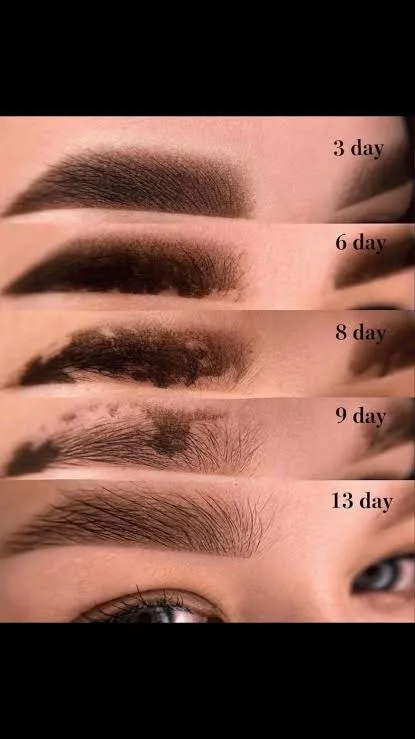
Day 1 to 3: darker and sharper than you asked for
Right after the session the brows look bold, crisp and about a shade darker than the colour we agreed on. Some of that is pigment resting on the surface, some is the skin’s redness underneath. The area may feel warm and tight, like mild sunburn.
What to do: keep them dry. Wash your face around the brows, not over them. Apply the ointment I gave you in a thin film, twice a day, with a clean cotton bud. No makeup on the brows, no touching with fingers, no workouts, and sleep on your back if you can. If you wake up with a pillow crease through the brow, it fades by morning.
What not to worry about: the darkness. Take a photo on day one so you can compare it with day thirty and see how far it softens.
Day 4 to 8: flaking
A thin crust forms over the dots and starts to lift, usually from the tail of the brow first. It can look patchy for a few days, with some parts flaked and others still dark. Itching is common. This is the stage that decides how much pigment stays.
What to do: let every flake fall on its own. When you pick one off early it takes the pigment under it, and that spot heals lighter than the rest. Keep the ointment thin; a thick layer softens the crust and makes it lift too soon. Still no water on the brows beyond a quick wipe, still no makeup.
What not to worry about: a flake with colour on it. That is the surface layer, and the pigment that matters is still in the skin.
Day 8 to 14: the pale week
The flakes are gone and the brows look far lighter than you wanted, sometimes almost gone. Clients call this the ghost stage. New skin has grown over the pigment and it is not yet transparent.
What to do: nothing, and I mean it. This is the week people panic and book a second session somewhere else, or draw over the brows with pencil, or scrub them. The pigment is there. You can go back to your usual face wash on the brows from day ten and start wearing brow makeup over them if you must, though I would rather you waited until day fourteen.
Week 3 to 4: the colour returns
Day by day the new skin clears and the colour comes back through it, softer and more even than the fresh version. By week four you are looking at roughly ninety per cent of the final result. This is the first point where a fair judgement of shape and tone is possible, and it is when I ask clients to send me a photo in daylight.
On oily skin the healed colour can come back a touch lighter and cooler than on dry skin. That is expected and it is one reason I choose a slightly warmer pigment for oily skin at the start.
Week 6 to 8: the retouch
Skin never heals perfectly evenly. A few dots always hold less pigment than their neighbours, and only a full heal shows where. At the retouch I fill those spots, refine the shape now that you have lived with it, and adjust the colour if it healed warmer or cooler than we planned. The visit is shorter than the first session, the numbing is the same, and the healing repeats in a milder form: three days bold, a few days of light flaking, then done.
The retouch is part of the price, not an extra. Skipping it leaves the brows at ninety per cent for good.
After that: what keeps the colour
- Sunscreen on the brows every day you are outside. Sun is the biggest single reason brows fade early in Manila.
- Keep acids, retinol and scrubs off the brow area. They exfoliate pigment along with skin.
- Expect a colour boost every eighteen months to three years, sooner on oily skin, later on dry.
When to message me instead of waiting
Heat, swelling and redness that get worse after day three rather than better. Yellow crust rather than a thin dry one. Pain rather than tenderness. These are rare, and they are the ones I want to see the same day. Everything else on this page is normal and I would rather you saved the photo for the day-thirty comparison.
The brow techniques themselves, powder and ombre, and who each suits, are on the brows page. If you are still deciding, the consultation is free and takes twenty minutes.
Questions about healing
My brows look almost gone on day ten. Did the pigment not take?
No. The surface skin that flaked off was holding the top layer of colour, and the new skin over the pigment is still cloudy. Between days 14 and 28 the colour comes back through as the skin clears. Almost everyone messages me at day ten. Almost nobody needs anything done.
Can I put makeup on my brows while they heal?
Not on the brows themselves for ten days. Foundation, powder and brow products carry bacteria and pull flakes off early, and each flake takes pigment with it. Makeup around the brows is fine from day one.
Why do I need a retouch at all?
Skin heals unevenly. A few spots always hold less pigment than the rest, and the only honest way to see them is to wait for the full heal. The retouch fills those spots and adjusts the colour now that you have lived with it for six weeks.
Can I swim or go to the gym?
Not for the first week. Chlorine, salt water and sweat all pull pigment out of skin that has not closed. Light walking is fine; anything that makes you sweat on the face waits seven days.
The colour looks reddish or greyish after healing. Is that normal?
A slight shift is normal and it is why I mix pigment against your skin, not from a chart. A strong colour shift is a retouch matter, and it is included: I correct the tone at the six to eight week visit.
More guides from Kate
- Eyebrow tattoo vs microblading: which one to get in Manila
- Nano brows vs powder brows: which one holds on Manila skin
- Brow lamination vs brow tattoo: which one fixes your brows
- Does eyebrow tattoo hurt? What the session feels like
Services: Eyebrow tattoo · All guides
Book a free consultation
Twenty minutes with Kate in Salcedo Village. Shape, colour and price, no obligation.